Buyer's guide
Security radios: a buyer's guide to two-way radios for guards and door teams
This guide is for security companies, venue and site managers and door team leaders choosing two-way radios in the UK. It covers licence-free and licensed radios, analogue and digital, earpieces, emergency and lone worker alarms, battery life, radios for mobile patrols, and the Ofcom licence. It also sets out what Martyn's Law says about communication.
The short answer
What most security teams use
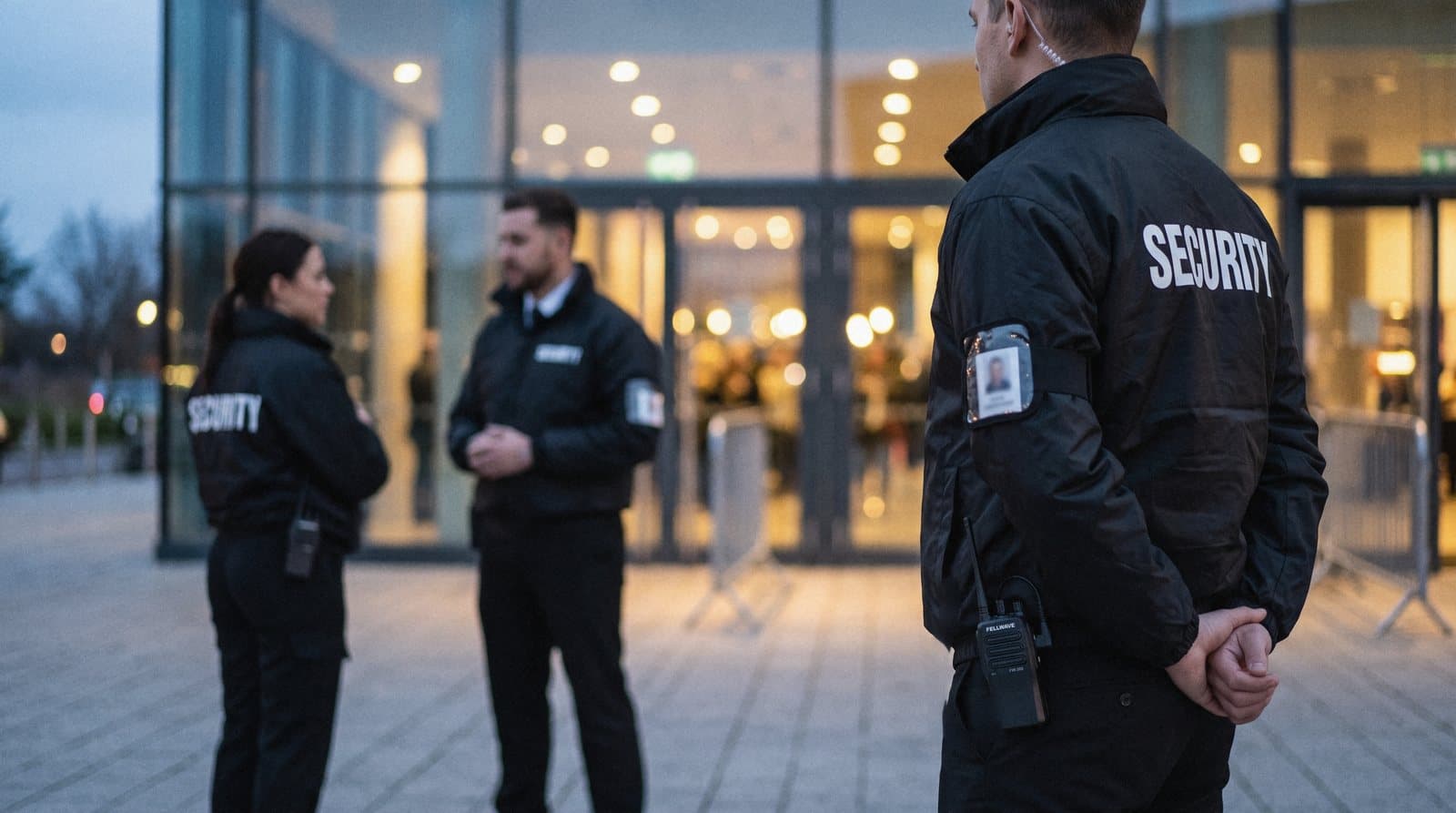
Most guarding, door and event security teams in the UK use licensed UHF handhelds of 4 or 5 watts with an acoustic-tube earpiece. The radios are programmed to frequencies on an Ofcom business radio licence, which keeps the team off the walkie-talkie channels the public use.
Many digital (DMR) radios add an emergency button that identifies the radio, lone worker alarms and encryption. Analogue radios are simpler and do the basic job of letting the team talk.
Handhelds reach across a site. Teams that patrol by vehicle or work across several sites need either a repeater on each site or radios that use the mobile network.
Our page on radios for security teams lists what we supply. This guide explains the choices behind it.
Before choosing radios
Questions to answer first
- How many people need a radio on the busiest shift
- Whether the team stays on one site or moves between sites
- Whether anyone works alone, and who would respond to an alarm
- Whether what is said on the radio needs to be kept private
- Whether a control room or supervisor needs to see who is calling
- How long a shift is, and where radios will be charged
- Whether the radios are for one event or a permanent contract
The options
The four kinds of security radio compared
| Kind of radio | What it is | Licence | Privacy | Suits |
|---|---|---|---|---|
| Licence-free PMR446 | Handhelds limited to half a watt with a fixed antenna. Handheld to handheld only, with no base stations. | None. | 16 channels shared with the public. Anyone nearby with a PMR446 handset can listen and talk on them. | Two or three staff in one small building. |
| Licensed analogueFellwave FW-300 | Handhelds of up to 5 watts with removable antennas, on business radio frequencies. | Simple UK Light, £75 for five years. Hired radios run on the hire company's licence. | Not on the public walkie-talkie channels, but not encrypted. A scanner tuned to the frequency can receive it. | Door teams and event security who want a radio with a channel knob and no menus. |
| Licensed digital (DMR)Hytera PD405 | The same power and frequencies as licensed analogue, with digital audio, radio IDs, emergency alarms and encryption. | The same licence as analogue. | With encryption switched on, calls cannot be heard on a consumer scanner. | Guarding contracts, control rooms and lone patrols. |
| Push-to-talk over the mobile networkRevoNet Handheld | A radio with a SIM that carries calls over the mobile networks to everyone in the talkgroup, wherever they are. | No Ofcom licence. A monthly service covers the SIM and the network. | Calls are encrypted, and each device has to be approved by your administrator. | Mobile patrols, keyholding and response, and contracts spread over several sites. |
Licence-free or licensed
PMR446 against licensed radios for guarding
PMR446 is the licence-free walkie-talkie standard. Ofcom limits it to half a watt, to handheld use only, and to 16 analogue channels between 446.0 and 446.2 MHz. Ofcom describes the service as non-protected, which means nobody has a right to a clear channel. Any member of the public with a PMR446 handset can listen to those channels and talk on them.
The numbered “privacy codes” on PMR446 radios stop you hearing other users on the channel. They do not stop other users hearing you.
A licensed handheld transmits at up to 5 watts, ten times the power of PMR446, and has a removable antenna. It reaches further and gets through walls better. As a rough guide, a 5 watt handheld reaches 2 to 3 km in open country and much less inside and between buildings. Where one handheld cannot reach another across a site, a repeater relays the signal.
Licensed radios are programmed to frequencies on the user’s own Ofcom licence, or on the hire company’s licence for hired radios. The frequencies on the standard licence are shared with other licence holders, not with the public. A channel assigned to one site needs a Technically Assigned licence.
Analogue or digital
What DMR and encryption do
Analogue radios send the voice as an FM signal. Voices sound natural and the signal fades gradually at the edge of range. An analogue radio such as the FW-300 has a channel knob, a volume knob and a talk button, and nothing to configure on shift.
DMR is the digital standard used by Hytera, Motorola and our own FW-600 and FW-700. Each radio has an ID, so a display radio or a control room can see who is calling. DMR radios can call one person or a group, send an emergency alarm, and encrypt speech.
Encryption scrambles the speech with a key programmed into every radio in the fleet. With it switched on, the channel cannot be heard on a consumer scanner or on another organisation’s radios. The levels differ between models: the Hytera PD405 has basic encryption, and the Motorola R7 has an AES-256 option.
Encryption does not add range, and it only applies on digital channels. A lost radio still holds the key. Radios such as the FW-600 and PD405 can be disabled remotely, and that should be done as soon as a radio is reported missing.
Listening to radio messages not meant for you is an offence under section 48 of the Wireless Telegraphy Act 2006. The law does not prevent an analogue channel being received, so anything confidential belongs on an encrypted channel.
Alarms and battery life
Emergency buttons, lone worker and man down
An emergency button sends an alarm to the rest of the group and the control room. On the radios marked “with radio ID” below, the alarm shows which radio raised it. It can also be programmed to open the microphone so the control room hears what is happening.
A lone worker timer asks the user to press a button at set intervals and raises the alarm if they do not. Man down raises the alarm by itself if the radio tips over or stays still.
The Health and Safety Executive says employers must monitor lone workers and keep in touch with them. Its guidance lists radios among the ways of keeping contact, and devices that raise the alarm manually or automatically.
An alarm is only useful if someone receives it and knows what to do. Decide who that is on every shift before relying on these functions, and test them.
| Radio | Type | Emergency button | Lone worker timer | Man down | Battery life |
|---|---|---|---|---|---|
| Fellwave FW-300 | Analogue | No | No | No | At least 24 hours with average use |
| Fellwave FW-600 | DMR, with display and keypad | No | Not listed | Not listed | Up to 12 hours of use |
| Hytera PD405 | DMR | Yes, with radio ID | Yes | Not listed | 16 hours digital, 22 with the 2000 mAh battery |
| Hytera HP605 | DMR, IP68 | Yes, with radio ID | Yes | Yes | 20 hours, 30 with the 3000 mAh battery |
| Motorola R2 | DMR | Yes, with radio ID | Yes | Not listed | 26.5 hours digital |
| Motorola R7 | DMR, IP68 | Yes | Yes | On Capable and Premium versions | 19 to 25 hours digital, depending on the battery |
| RevoNet Handheld | Push-to-talk over the mobile network | SOS button to the control room | Not listed | Not listed | Ask us |
Figures and functions are the ones on each product page. “Not listed” means the product page does not mention the function, so ask us before relying on it. Battery figures are for a new battery with average use. A radio that transmits often runs down sooner, and batteries lose capacity as they age, so keep a charged spare for anyone on a 12-hour shift.
Earpieces
Earpieces and covert kits
Acoustic tube
A clear tube carries the sound to a mould in the ear, with a push-to-talk button and microphone on the lead. It is the usual earpiece for door and guarding work because it is discreet and the radio stays on the belt.
One, two and three-wire kits
A two-wire kit puts the earpiece on one lead and the microphone and push-to-talk on another, so the button can sit at the chest or cuff. One-wire and three-wire versions are also made.
D-shape
A soft hook holds the speaker on the outside of the ear. It suits long shifts and staff who do not want anything in the ear canal.
Speaker microphones
A speaker and microphone on the shoulder for staff who do not need to keep calls private. Some have their own emergency button, such as the Hytera SM26N1-P for the HP605 and the Motorola RM730 for the R7.
The plug has to match the radio
Our Fellwave radios take Kenwood-style 2-pin plugs. The Hytera BD505 and PD405 use Hytera's 2-pin plug, the Motorola R2 has its own, and the HP605 and R7 use multi-pin side connectors. An earpiece bought for one will not fit another.
One earpiece per person
We recommend an earpiece for each person, not a shared pool. Hire earpieces are replaced between hires, not cleaned.
Patrols and several sites
Where handhelds will not reach
Handheld radios talk directly to each other, so their range is limited to a site and its surroundings. A repeater extends that across a large site or a town centre. It does not connect a patrol vehicle to a control room in another town.
Push-to-talk over cellular radios look and work like a two-way radio, but carry the call over the mobile networks. The RevoNet Handheld we supply uses a SIM that works across the UK networks, so a guard on one site, a patrol driver and a supervisor in another city can be in the same talkgroup. It has an SOS button, and the control room can talk to every radio and see where each was last seen from a web browser.
The RevoNet Mobile is the version for patrol and response vehicles and control desks. It shares talkgroups with the handhelds.
These radios need no Ofcom licence and are supplied on a monthly service. They depend on mobile coverage, so a basement or a remote site with no signal still needs licensed radios. Phone networks also slow down when a large crowd is on one mast, which is why event security normally runs on licensed radios.
RevoNet can be tried first: three radios for two weeks on your own sites, against a refundable deposit.
Town schemes
Shopwatch and Pubwatch
A Shopwatch or Pubwatch scheme puts member businesses on a shared private radio channel, usually linked to the council CCTV control room. Most run on DMR or analogue UHF. A door team or store guard can only join with the scheme operator’s agreement, and the radio has to be programmed to the scheme’s channel. See radios for Shopwatch and Pubwatch.
Cameras
Body-worn cameras are a separate device
A body-worn camera records video and sound as evidence. A radio lets the team talk to each other. One does not do the other’s job, and they are bought and managed separately. Camera footage of people is personal data, and the Information Commissioner’s Office publishes guidance on using body-worn video.
Licence
£75 for five years
A Simple UK Light licence covers licensed handhelds and vehicle radios anywhere in the UK. It is issued to the organisation that uses the radios and the fee is paid to Ofcom. It does not cover base stations or repeaters, which need a site licence. An SIA licence covers the person, not the radio. See licence types and costs.
Martyn’s Law
What the Terrorism (Protection of Premises) Act 2025 requires
The Terrorism (Protection of Premises) Act 2025, known as Martyn’s Law, received Royal Assent on 3 April 2025. Its requirements were not yet in force when this page was last checked. The government expects them to come into force in spring 2027 and has not yet confirmed the date.
The Act applies across the UK. It covers premises used for purposes listed in the Act where 200 or more people can reasonably be expected to be present at the same time, and public events where 800 or more are expected. Premises expecting 200 to 799 people are in the standard tier. The enhanced tier, at 800 or more, has further requirements. The Security Industry Authority is the regulator.
The person responsible for standard tier premises must notify the SIA and have public protection procedures in place, so far as is reasonably practicable. There are four kinds of procedure: evacuation, invacuation, lockdown and communication.
Where radios fit
The Act does not require radios
The statutory guidance says there is no requirement in the Act to make physical alterations or to buy specific equipment for the procedures.
On communication, the guidance asks the responsible person to consider how staff will communicate with each other, how information will reach the people who make decisions, and how it can be shared quickly. It names public address systems, loudhailers, radio systems and alarms as methods that could be used at larger premises, and spoken instructions at smaller ones.
Radios are one way to meet that part of a procedure. A channel that every member of staff can hear lets one person tell the whole team to start an evacuation or a lockdown at the same moment. Whether a venue needs them depends on its size and layout and on how staff are spread across it.
Read the statutory guidance itself before writing procedures. The link is in the sources below.
Hire, lease or buy
One-off events against permanent contracts
Hire for events and short contracts
Hired radios arrive programmed and charged, with chargers and a hard case, and run on our Ofcom licence for up to a year. Hire starts at £12.50 per radio per week, with earpieces extra. See radio hire or price it on the quote page.
Lease for a guarding contract
A lease is £12.99 a radio a month for the Fellwave FW-700, with a 12-month minimum term. It includes your own Ofcom licence, earpieces, replacement batteries and a swap of any faulty radio. See radio leasing.
Buy to own the fleet
Buying suits a company that wants to own its radios and have its own people look after them. We programme the radios and apply for the Ofcom licence in your name. See buying radios, or what each of the three costs.
Questions about security radios
What radios do security guards use in the UK?
Most guarding and door teams use licensed UHF handhelds of 4 or 5 watts, either analogue or digital (DMR), with an acoustic-tube earpiece. Teams that cover several sites or patrol in vehicles often use push-to-talk radios that work over the mobile network, because handhelds only reach across one site.
Do security guards need a licence to use two-way radios?
Licence-free PMR446 radios need no licence. Any more powerful handheld needs an Ofcom business radio licence held by the organisation that uses it. The usual one is Simple UK Light, which costs £75 for five years. Hired radios run on the hire company's licence. An SIA licence is a separate thing: it covers the person doing the security work, not the radio.
Are licence-free walkie-talkies good enough for security work?
They can be for a couple of staff in one small building. They are limited to half a watt, so the signal struggles through walls and across a large site, and they use 16 channels shared with the public, so anyone nearby with the same kind of radio can hear what is said.
Can other people listen to security radios?
Analogue radios, licence-free or licensed, can be received by anyone with a radio or scanner on the same frequency. Listening to messages not meant for you is an offence under the Wireless Telegraphy Act 2006, but that does not stop it happening. Digital radios with encryption switched on cannot be heard on a consumer scanner.
Which security radios have an emergency button?
Of the radios we supply, the Hytera PD405 and HP605 and the Motorola R2 and R7 have an emergency function on digital channels. The RevoNet Handheld has an SOS button that alerts the control room. Our own FW-300 and FW-600 do not have one.
Will a radio battery last a 12-hour shift?
Most current handhelds will on their standard battery. The FW-300 is rated for at least 24 hours with average use, the Hytera PD405 for 16 hours on digital and the Motorola R2 for 26.5 hours. The FW-600, with its colour display, is rated for up to 12 hours of use, so a spare battery is sensible on a long shift.
How do mobile patrols stay in touch between sites?
Handheld radios talk directly to each other and reach across one site, not between towns. For patrols and multi-site contracts we supply RevoNet push-to-talk radios, which work over the UK mobile networks wherever there is coverage and need no Ofcom licence. A vehicle version shares the same talkgroups as the handhelds.
Does Martyn's Law require a venue to have radios?
No. The statutory guidance says the Act does not require physical alterations or the purchase of specific equipment. It requires procedures for evacuation, invacuation, lockdown and communication so far as is reasonably practicable, and it lists radios as one of the methods a larger venue could use to share information quickly.
Should a security company hire, lease or buy radios?
Hire suits one-off events and short contracts: the radios arrive programmed and are covered by our Ofcom licence. A permanent contract is usually cheaper on a lease, which includes the licence in your name, earpieces, replacement batteries and swaps of faulty radios. Buying suits a company that wants to own and look after its own fleet.
Sources
Where the facts on this page come from
Checked against these sources on 25 November 2026. Rules and official advice change, so follow the links for the current wording.
- Ofcom: licence-exempt devices
- Ofcom: Analogue and Digital PMR446 information sheet
- Ofcom: business radio licence fees and payment
- Ofcom: rules on using radio equipment
- Wireless Telegraphy Act 2006, section 48
- HSE: lone working, training, supervision and monitoring
- GOV.UK: find out if you need an SIA licence
- GOV.UK: Terrorism (Protection of Premises) Act 2025 statutory guidance
- GOV.UK: Terrorism (Protection of Premises) Act 2025, standard duty requirements factsheet
- GOV.UK: understanding Martyn's Law and the SIA's role as regulator
- ICO: body worn video
Enquire
Ask us about radios for your security team.
Tell us how many people need a radio, whether they stay on one site or move between sites, and whether it is for an event or a contract. We reply within one working day.
- Email[email protected]
- Phone0333 340 9646
- WhatsAppMessage us on WhatsApp
- Monday to Friday, 08:00–18:00. Out-of-hours support for live events by arrangement.
Want a rough price first?
The quote calculator gives an estimate from the number of radios and the length of hire.
Get a price in 20 seconds